"Feminist movements were visual from the beginning”
One powerful way to stand up for one’s rights in the public space is the protest poster - it spreads a message and helps rally support. Powerful slogans and stunning visuals advocating for women’s rights pop up on posters during International Women Rights’ Day demonstrations and activities.
Posters were used in support of the emancipation of women very early on in the history of this movement. As Christine Dupont, curator at the House of European History, writes in her article "Advocating for women’s rights" in the When Walls Talk catalogue: “Feminist movements were visual from the beginning”.
The House of European History collection contains several outstanding examples of this phenomenon, two of which, designed 100 years apart from one another, are documented and presented on the museum’s online collection.
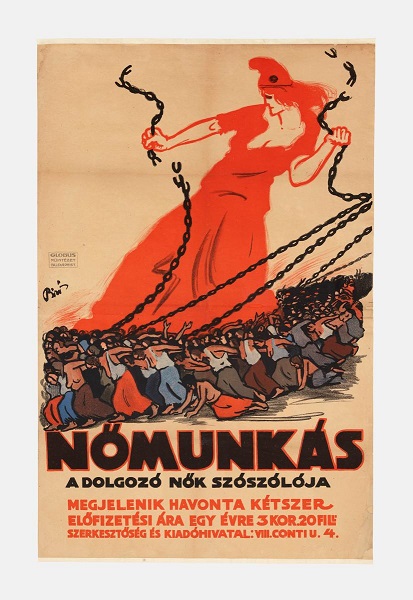
Nőmunkás (The Woman Worker), 1918
Hungarian artist Mihály Bíró designed a poster advertising for the socialist women’s journal The Woman Worker, representing a feminine figure symbolising the power of the working class. Red, strong and bearing the Phrygian hat, she symbolises freedom and revolution. She breaks the chains of a huge crowd of poor and exhausted women represented as enslaved.
The workers’ movement, which was organised under the banner of socialist parties, supported women’s suffrage. Women officially obtained the right to vote in Hungary in November 1918. However, due to the many voting restrictions introduced by successive regimes, universal suffrage was only truly granted in Hungary in 1945.
Trade unions often take the opportunity of the now institutionalised celebrations on 8 March, to remind people that equality between men and women has still not been achieved at the workplace.

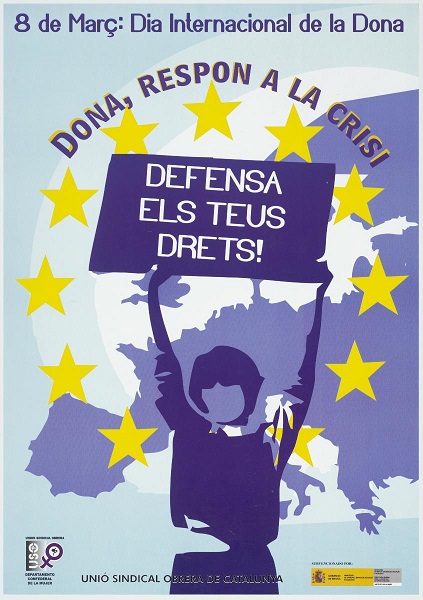
Dona, respon a la crisi. Defensa els teus drets!, 2012
In this poster published by the Spanish Workers Trade Union for the International Women’s Day in 2021 - here in its Catalan version - the slogan and claim recall the economic crisis affecting Europe since 2008. The European circle of stars and the map of Europe in the background highlight the strong commitment for equal work opportunities between women and men promoted by the European Union.
In 2022, the When Walls Talk! exhibition at the House of European History displayed a visual history of Europe through posters using the museum’s own poster collection acquired in 2014. As museum director Constanze Itzel writes in her Preface to the exhibition catalogue, “[Posters] are a testimony and an expression of European history but one might argue that they were also actors in this history”.
On Sunday 8 March, let us learn from women’s history - and continue to make it - through posters.