
Date
20 June 2026, 10:00 (CEST) - 21 June 2026, 18:00 (CEST)
Location
House of European History, 135 Rue Belliard/straat, 1000 Brussels, Belgium

This two-day event co-curated by Maria Galindo and La Candidate Sans-Papiers brings together women from formerly colonised countries for an international gathering aimed at collectively staging, from situated knowledge of colonial legacies in Europe, the transformative power of alliances against current migration policies. 

Engaged citizens, community members and associations are invited to participate in workshops, discussions, and public talks. The event is open to the public and will culminate in an open public assembly with performative incursions. Interested parties can register for one or all sessions, at the link below.

Event sessions

Saturday 20 June 

Workshop - 10.00-13.00 - EN - Max. 20 participants

A co-writing workshop on a new migration path.

Co-curator: Maria Galindo. With: Adilia de las Mercedes

Performative Assembly  - 14.30-17.30 - EN-ES-FR - Max. 90 participants

A facilitated public assembly with performative incursions, reading European colonial legacies through current migration policies and proving the transformative potential of alliances. 

Co-curator: La Candidate Sans-Papiers. With: Territorio Domestico, Comisión de migración y antirracismo del Movimiento 8M, Ministère du Care, Collecti.e.f 8 Maars. Guests: Maria Galindo and Rita Segato. Moderated by: La Laboratoria.

Sunday 21 June

Public talk & roundtable - 15.00-18.00 - EN-ES-FR. Max. 90 participants.

Starting with a performance by Maria Galindo, the talk and roundtable will address gender, migration and exploitation.

Co-curator: Maria Galindo. With: Rita Laura Segato & Adilia de las Mercedes. Guests: La Candidate Sans-Papiers.
Register for an event session

Co-curator bios

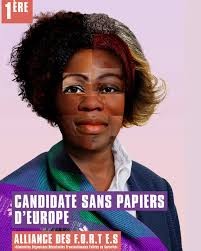
La Candidate Sans-Papiers d’Europe
Europe's first undocumented candidate ran in the 2024 Brussels municipal elections as a fictional political figure, to support the demand for regularisation of hundreds of thousands of migrant citizens. Through a prefigurative artistic strategy — one that enacts and embodies desired futures rather than simply demanding them — the Candidate Sans-Papiers d’Europe shifts the narrative away from victimization, grounding it instead in the dignified, first-person perspectives of those most concerned.
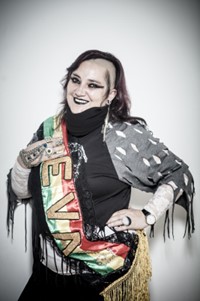
Maria Galindo
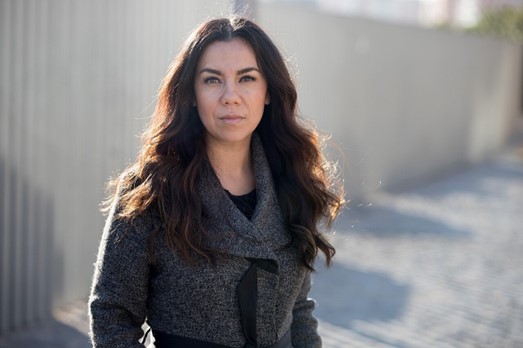
Maria Galindo is a Bolivian feminist activist, writer, performer, and co-founder of the anarcho-feminist collective Mujeres Creando. Her work combines political activism, public intervention, radio, performance, and writing to challenge patriarchy, coloniality, racism, neoliberalism, and institutional forms of power. Through a radical and deeply situated feminist practice rooted in Latin American social struggles, Galindo has become one of the most influential voices in contemporary decolonial and anti-patriarchal thought.

Guest bios

Territorio Doméstico
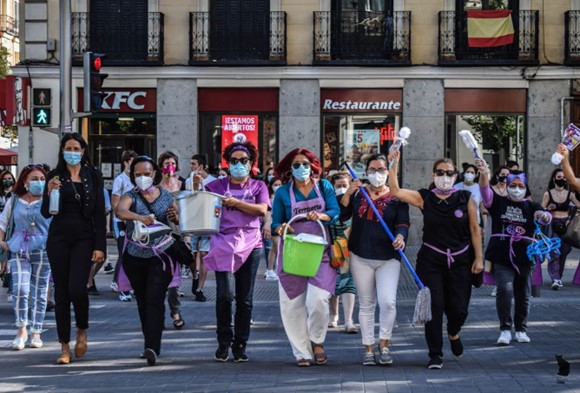
Territorio Doméstico is a collective space of struggle and empowerment by and for women, mostly migrants and domestic and care workers who fight for the recognition of their rights as domestic workers and carers, but also so that life-sustaining care work be recognized as imperative for everyone. Born in 2006 as a space of encounter between the Agencia de Asuntos Precarios, Servicio Doméstico Activo and the Cita de Mujeres de Lavapiés, Territorio Domestico is a diverse, mestizo and transborder collective who also fights against perverse immigration policies and an economic system that plunders territories and human rights, commodifies the right to migrate, and privatizes people’s right to be cared for.
Comisión de migración y antirracismo del Movimiento 8M de Madrid
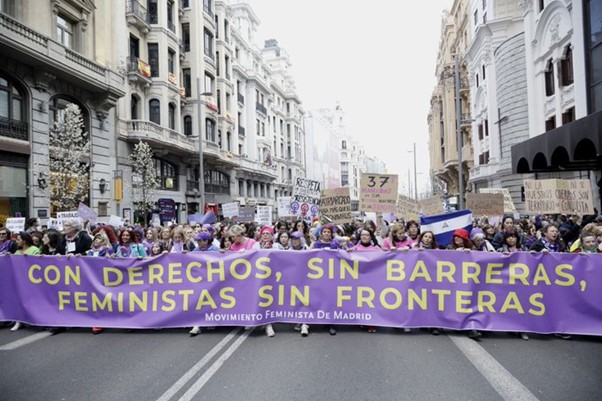
The Comisión de migración y antirracismo del Movimiento 8M de Madrid is a group of migrant women and dissidents, people of color, first and second generation, with or without papers. They are the ones on the margins, the ones the system needs to sustain its privileges, yet denies rights to. They define themselves from the border, from mixed-race, hybrid, and rebellious identities. From there, they build feminisms by prioritizing their discriminated and marginalized voices, challenging the notion that Western feminism is the only path to liberation. Their resistance is ancestral, political, and cultural; it is anti-racist, anti-capitalist, and transfeminist; it is a struggle against coloniality.
Rita Segato
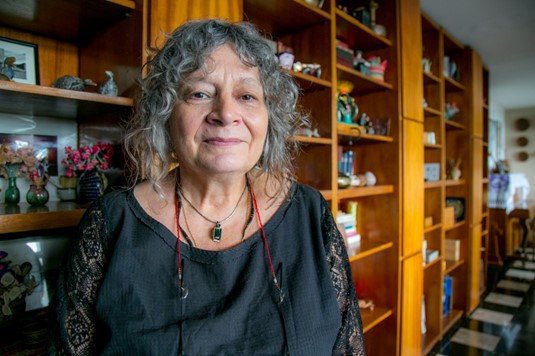
Rita Segato is an Argentine-Brazilian anthropologist, feminist thinker, and writer whose work has profoundly shaped contemporary debates on gender violence, coloniality, racism, and power in Latin America. Through a decolonial and interdisciplinary approach, her research analyses the relationship between patriarchy, state violence, extractivism, and the historical structures inherited from colonialism. Segato is internationally recognised as one of the leading voices in contemporary Latin American feminist thought.
Adilia de las Mercedes
Adilia de las Mercedes is a legal practitioner, activist, and cultural mediator engaged in questions of migration, rights, and social justice. Her work bridges legal expertise and political engagement, focusing particularly on the lived realities of migrant communities, structural inequalities, and forms of collective resistance. Through her practice, she contributes to creating spaces of visibility, advocacy, and empowerment grounded in lived experience.
La Laboratoria
La Laboratoria is a feminist transnational hub practicing militant research, radical pedagogy and feminist biosyndicalism in collaboration with grassroots feminist and migrant collectives in Spain and Latin America.