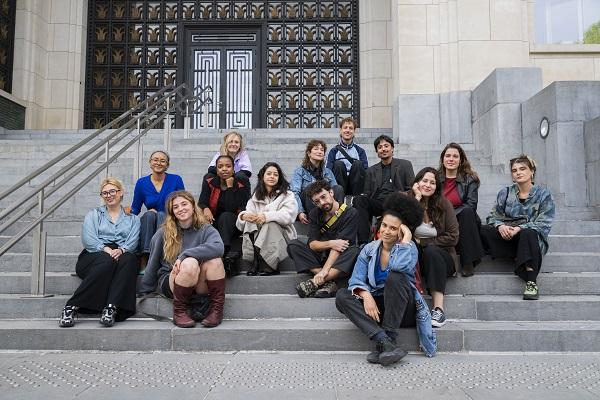
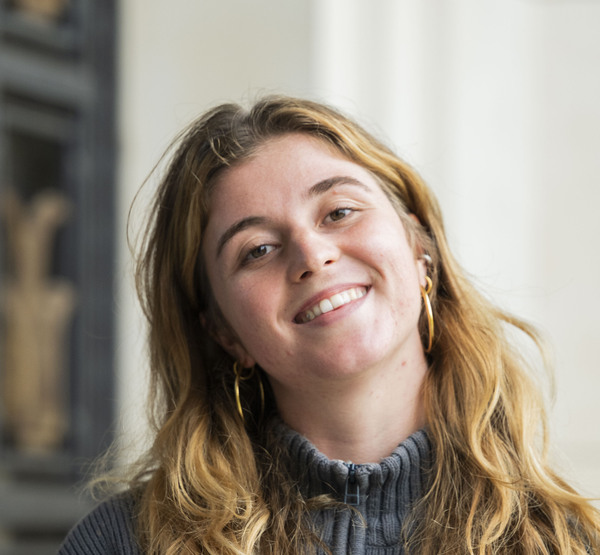
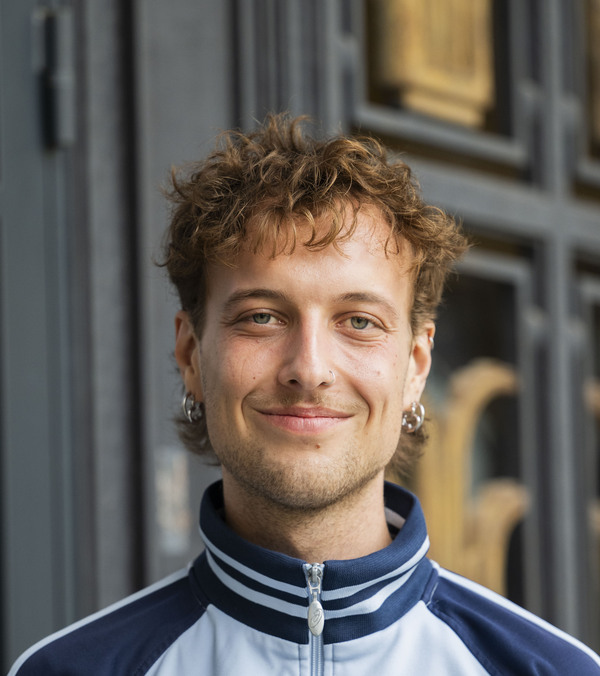
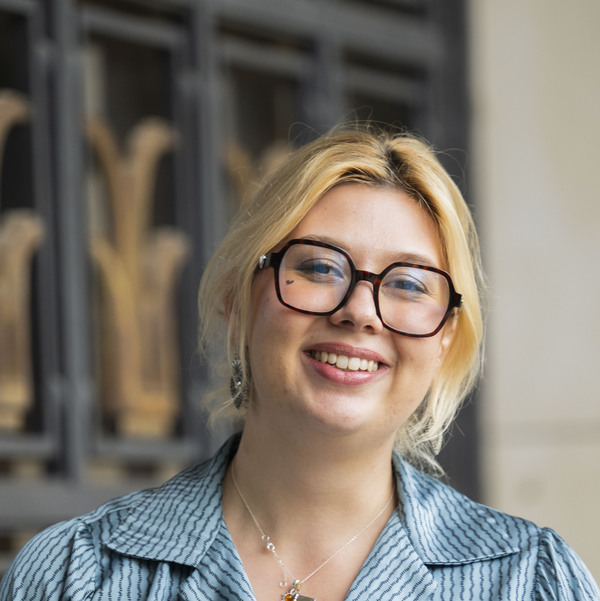
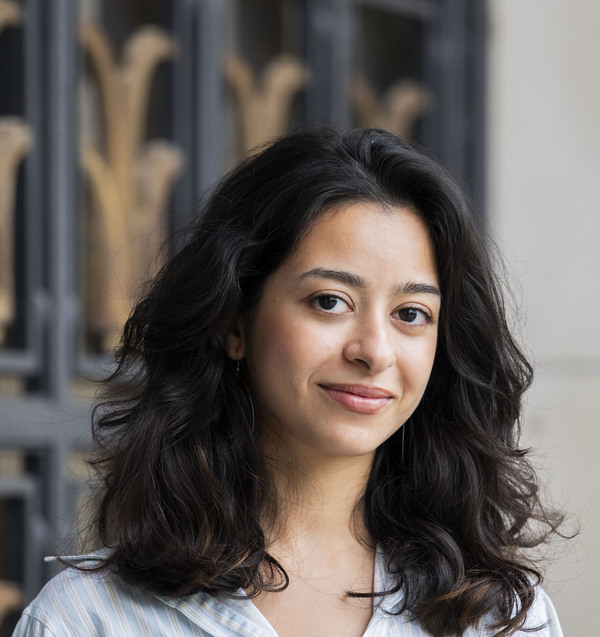
Over the coming months, a group of young adults will reflect on the museum's permanent exhibition and respond to it by creating their own installation in the museum. Their work will feature stories and voices collected in Brussels, which will be presented at the opening of History Lab Europe in May 2027.

Along the way, the Echoes collective will regularly meet professional artists and researchers. Together, they will explore how creative mediums can address archival silences and gaps in historiography. Facilitators from the House of European History, GSARA and Synapse will guide and structure the co-creation process.

Meet the Echoes collective

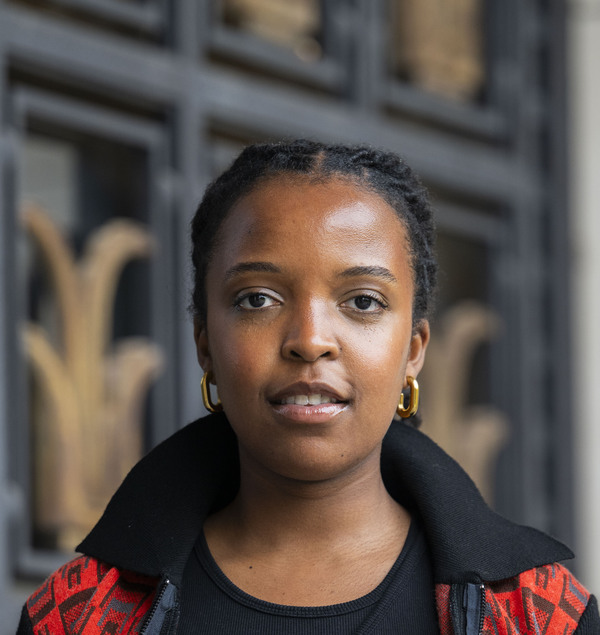
Latifah
Latifah Abdou has worked on decolonisation and epistemic justice for several years. She founded WeDecolonizeVUB, which centres the knowledge, experiences and needs of racialised youth in higher education. She co-authored the Blueprint Study: Master in Critical Diaspora, Race and Liberation Studies and co-founded the Braver Spaces Summer School. As a Rwandan diaspora living in Brussels, with a background in Political Science and African Studies, she centres the stories and knowledges of marginalised communities while exposing the power dynamics behind their marginalisation.
Zem
Zem Azem graduated in 2025 with a Master’s in Typography (teaching track) from ERG and is a multidisciplinary artist and an art and digital media teacher. Her practice focuses on counter-narratives, speculative fiction, and how the collective can restore agency to what is usually invisibilized. She draws on pop culture to design participatory workshops, such as her video game creation workshop at Palais de Tokyo. Currently in residence for the Echoes project, she brings this action-research approach to collectively explore new narrative and visual archives.
Sophie
Sophie Constantin is a Belgian-Lebanese journalist and archaeologist with a background in Art History and Archaeology. She spent nearly three years reporting on culture and heritage for The Jordan Times in Amman. Interested in the intersections of heritage, conflict, identity and collective memory, she founded Heritage Under Fire, an independent journalism project documenting threats to cultural heritage across West Asia and North Africa. Through research, interviews and accessible reporting, she bridges archaeology, journalism and international affairs.
Ángel
Ángel Ferreiro Calvete is a multidisciplinary artist from Gran Canaria, in the Canary Islands. Although he has lived away from the island since 2022, he has kept a strong connection to their roots and cultural identity. He studied History and Cultural Management, and his interests include music, painting, radio and audiovisual projects. He is currently an intern at a world music label in Brussels, working with artists from different cultural backgrounds. He sees Echoes as a chance to exchange ideas, meet people with different perspectives and explore the stories and voices that are often missing.
Lilo
Lilo Joris is a Brussels-based multidisciplinary practitioner. By day, he works in the administrative team at l’École de Recherche Graphique, where he graduated with a master’s in Design et Politique du Multiple, in collaboration with ULB. A colleague once described his role as “creating continuums”. His other practice lies between editorial design, writing and the exploration of the narrative structures that shape our worlds, in the hope of letting new imaginaries emerge through interconnected, non-chronological and empathic storytelling.
Grace
Grace Ndagijimana holds a master’s in African Studies from Ghent University and works as a teaching assistant. She is a member of WeDecolonize, a decolonial and anti-racist project at the VUB that grew out of a student initiative. An emerging researcher of Black and mixed-Black women’s art, writing and archives, she is shaped by feminist histories, visual arts and questions of representation. Through Echoes, she hopes to gain hands-on experience in the cultural sector.
Nour
Nour Outojane just co-concluded an artistic research project exploring how to reclaim Belgian institutional archives relating to gender-nonconforming people through artmaking. In Echoes, they hope to build on this practice and continue exploring counter-archiving as a collective practice that resists archival erasure and distortion.
Kate
Kate Peleman (she/her) is an artist and student of life. She studied Media and Information Design in Brussels and World Religions in Leuven, and is finishing an advanced Master’s in Cultural Anthropology. Her recent interest in cultural heritage and the missing voices in archives drew her to Echoes, where she looks forward to immersing herself in the conversations, the archives and the process of creating.
Samuel
Samuel Teichmann (he/him) is originally from Munich and recently moved to Brussels, where he is completing a master’s in Urban Studies at VUB/ULB. He is interested in how urban spaces shape identities and experiences, and in how the everyday lives of people in Brussels can become part of an exhibition. His focus is the representation of marginalised groups and how their voices challenge established narratives. Through Echoes, he hopes to meet people from different backgrounds, gain insight into museum work, and translate theory into something tangible and accessible.
Briana
Briana Urzică-Velicu is a storyteller, scholar and museum enthusiast who reads every wall label. Romanian history lessons that skipped the Roma led her to write her bachelor’s thesis at Utrecht University (politics, philosophy and history) on those missing pages. She then took the question off the page, organising events for a feminist organisation and volunteering with people from Eastern Europe living on the street, helping them find their way back to services and community.
Kawtar
Kawtar Waddi is a multidisciplinary artist and a graduate of the Fine Arts School of Casablanca, currently pursuing a Master’s in Curation in Brussels. Through curation and filmmaking, she explores the relationship between humans and their environment, as well as questions of accessibility. Her sound and archiving work portrays complex social interactions with her surroundings.
Nicole
Nicole Ranzato is a Brussels-based multidisciplinary artist enrolled in the ISAC Master Programme. Working at the intersection of writing and movement, she draws on waacking/punking, a club culture rooted in self-expression and resistance. From intimate and affective perspectives, she explores processes of resignification, with the body as a site of aesthetic, political and communal inquiry.
Georgia
Georgia Satchwell is an urbanist and cultural worker whose practice moves between social urbanism, experimental image making, textile design and archival research. Her master’s research on urban squatter movements in France and South Africa sharpened her attention to the politics and semantics of words, and to how they produce narratives and, in turn, more just urban transitions. Her interest in collective storytelling drew her to Echoes.
Khadija
Khadija Abrassart is a psychology student at ULB in Brussels. Alongside her studies, she is involved in student representation and various collective projects. She is particularly interested in the creation of new narratives: how we can tell different stories about our societies, challenge dominant representations and give visibility to experiences and voices that are often overlooked. Through her involvement in different initiatives, she has developed an interest in how the stories we tell shape our perception of the world and the way we live together.