- Date
- 7 September 2026, 13:00 (CEST) - 9 September 2026, 17:30 (CEST)
- Location
- House of European History, 135 Rue Belliard/straat, 1000 Brussels, Belgium
Inter-state unions and composite polities have been a significant phenomenon in European history. Often formed on the basis of a legal agreement or contract between the political units that form them, they represent an alternative to imperial power structures mainly based on military expansion and conquest.
Unions and composite systems played a greater role in the medieval and early modern history of Europe as a whole than empires. The legacy of these unions, whether regarded positively or negatively, forms an important part of cultures of memory in many European countries; their history is playing an increasingly significant role in the intellectual discourse on the prefiguration and models for the contemporary European Union.
The three-day international conference at the House of European History in Brussels aims to bring together researchers working on the history of European unions over the last thousand years.

Practical information
- The full programme is viewable as a pdf leaflet or on a webpage via the banner below.
- Registation is on the Saxon Academy of Sciences and Humanities website.
- Contact person for further information: silberhorn
saw-leipzig [dot] de (Agnes Silberhorn).
Public keynote
- Robert Frost, University of Aberdeen
- On Tuesday 8/9/26 from 16:00. When is a union not a union? Thoughts on composite political systems in late medieval and early modern Europe.
- Panel discussion
- Discussion on the forms and structures of political unions in the European history. With Ignacio Czeguhn, Robert Frost, Carsten Jahnke and Maciej Janowski.
Conference programme
Image credits
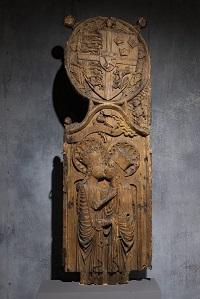
- Top banner image: King Eric (1382–1459) and Queen Philippa (1394–1430), the ruling couple of the Kalmar Union. Choir stalls from Kirkjubøur Cathedral, Faroe Islands, National Museum of the Faroe Islands.
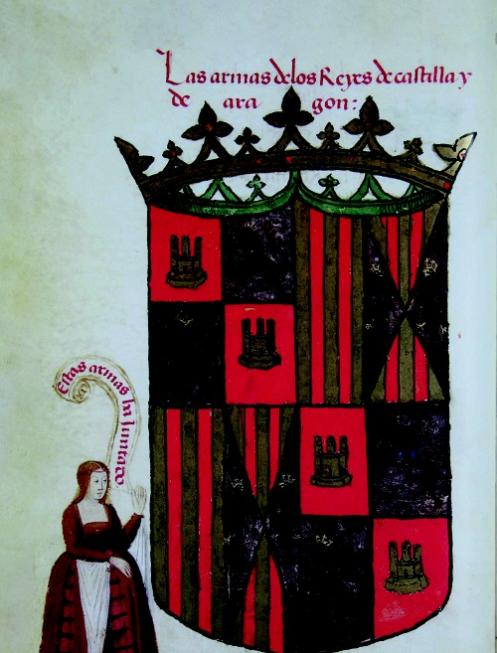
- Download banner image: Coat of arms of Queen Isabella I of Castile (1451–1504) and King Ferdinand II of Aragon (1452–1516); manuscript *Cancionero de Pedro Marcuello* (1502), Musée Condé in the Château de Chantilly.